
Global payout infrastructure is moving from bilateral bank links to multi-rail networks.
Moving money across borders is still fragmented. Every new corridor can mean another bank relationship, another local rail and another integration to maintain. For PSPs, banks and platforms with global users, that complexity slows expansion.
I evaluated these platforms for US and UK senders that need reliable global payouts. I focused on infrastructure fit, emerging-market reach, payout methods beyond wires, funding routes, pricing transparency and developer experience.
Airwallex is the best overall pick for platforms and scale-ups. It pairs payouts with multi-currency accounts, FX and public pricing.
Thunes is my top pick for one-integration network reach. It helps teams reach bank accounts, cards and mobile or stablecoin wallets without many bilateral links.
Nium is the strongest institutional choice. It suits banks, payroll platforms and EOR providers that need bank, wallet and card payouts.
Rapyd wins on payout method breadth. It supports bank transfers, cards, wallets and cash in many markets.
Stripe Connect, Payoneer and Wise Business cover specific platform needs. Stripe fits embedded platforms, Payoneer fits managed marketplace payouts and Wise Business fits batch payments.
I reviewed each platform the way a payment or finance lead would during a 2026 roadmap review, with more weight on infrastructure fit than marketing claims.
I weighed five checks: payout method mix beyond wires, corridor depth in emerging markets, funding routes such as local rails and balances, pricing transparency, and API clarity.


A cross-border payout platform lets you send outbound disbursements to recipients in other countries through one connection. Instead of maintaining bank relationships in every market, you route payouts to local rails, cards or wallets.
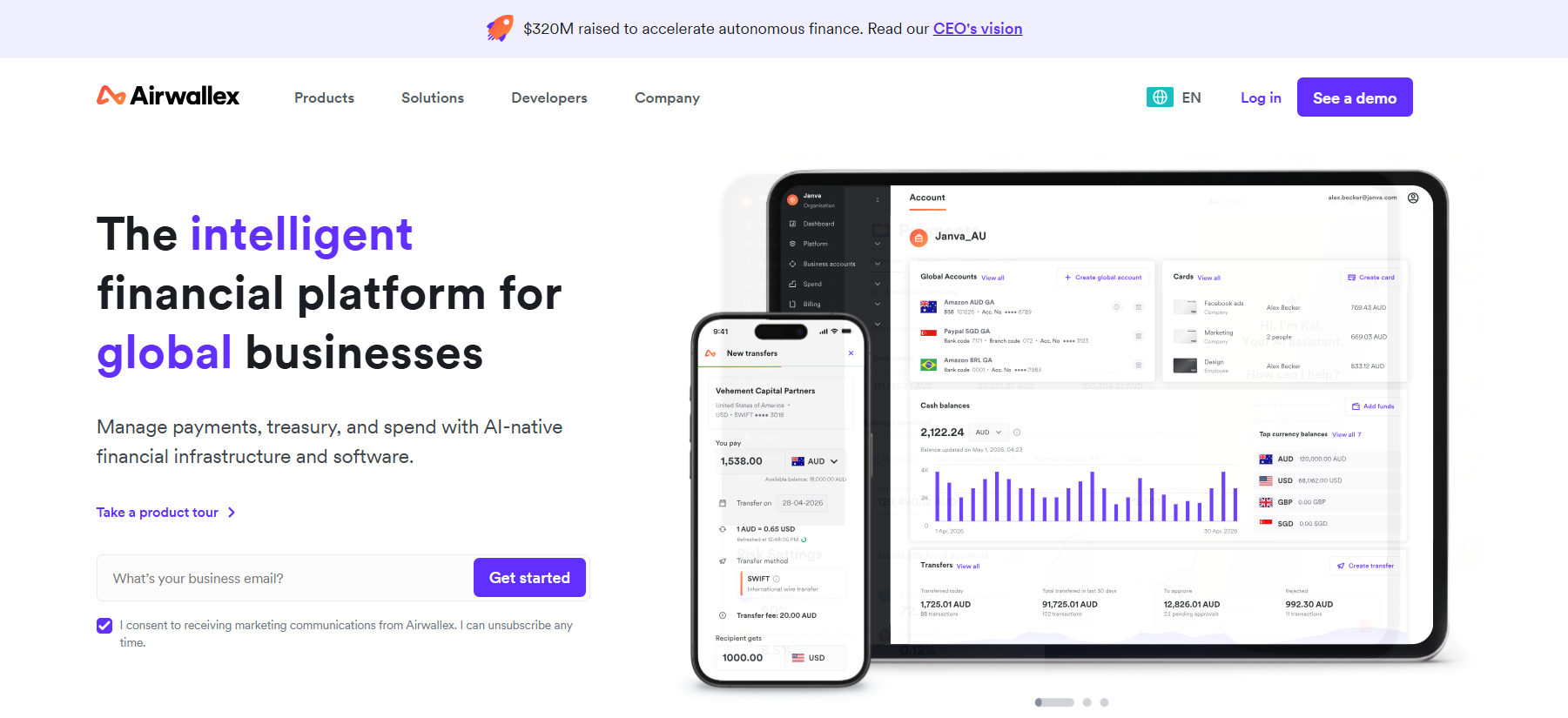
Best for: Growth-stage platforms and scale-ups that want payouts, multi-currency accounts and FX bundled with public pricing.
Airwallex pros
One-integration Payouts API for global platform payouts and seller withdrawals
Local transfers to 120+ countries listed as free on its US pricing page
Published FX markup for easier forecasting
Multi-currency accounts and FX bundled with payout tooling
Clear US pricing page for local and SWIFT transfer fees
Airwallex cons
SWIFT transfers can still carry per-transfer fees
Advanced features and quotes vary by region and volume
Complex setups need meaningful implementation work
Airwallex earns the top slot because it covers much of what a growth-stage platform needs, from pay-ins and payouts to multi-currency accounts and FX. That breadth helps when finance wants treasury tools and product wants payout automation in the same stack.
The pricing page is a real advantage for US and UK teams. Finance can model likely costs before engineering starts, which is useful when comparing multiple payout corridors.
If your roadmap needs both an operating account and programmatic global disbursements, Airwallex is the most complete fit in this ranking.
Airwallex lists FX markup as 0.5% for major currencies and 1.0% for others on its US pricing page. Local transfers to 120+ countries are shown as free, while SWIFT transfers to 200+ countries are listed at $15 to $25 per transfer.
Treat public pricing as a baseline and confirm your corridor mix during scoping.

Best for: PSPs, banks, gig platforms, payroll providers and EOR teams that want one-integration network reach across bank accounts, cards and mobile or stablecoin wallets.
Thunes pros
Single API access to popular global payment methods for cross-border payouts and collections
Supports payouts to bank accounts, cards and mobile or stablecoin wallets
Connectivity available through API or Swift, so it can fit existing infrastructure
Designed for banks, PSPs, gig platforms, e-commerce, payroll and EOR providers
Collections capability for accepting local payment methods alongside payouts
One network model that reduces reliance on bilateral bank relationships
Thunes cons
Pricing is sales-led, so there is no public rate card
Enterprise onboarding and configuration require a scoping conversation
Corridor-level coverage detail is confirmed during sales discussions
Thunes stood out as the clearest fit for teams that want one global payments network instead of a web of local bank integrations. The model is straightforward: connect once, then route payouts across multiple endpoint types as your market footprint grows.
In review, I liked that the same network concept applied to bank accounts, cards and mobile wallets through API or Swift. That makes it easier for payment teams to think in terms of recipient preference, not only bank-wire availability.
The industry framing is also practical. Gig platforms, PSPs, payroll teams and EOR providers all pay recipients differently, and Thunes presents its network around those real payout patterns. The addition of stablecoin wallet endpoints gives teams another way to meet recipients where they already operate.
For teams whose main constraint is reach across many methods and markets, this is the one-integration network I would put at the front of the shortlist.
Thunes uses quote-based enterprise pricing, so there is no public rate card to compare. That model is reasonable for a network sale as long as the scoping process is specific.
Before building, map your priority corridors and payout methods with Thunes, then align the commercial discussion to that footprint.
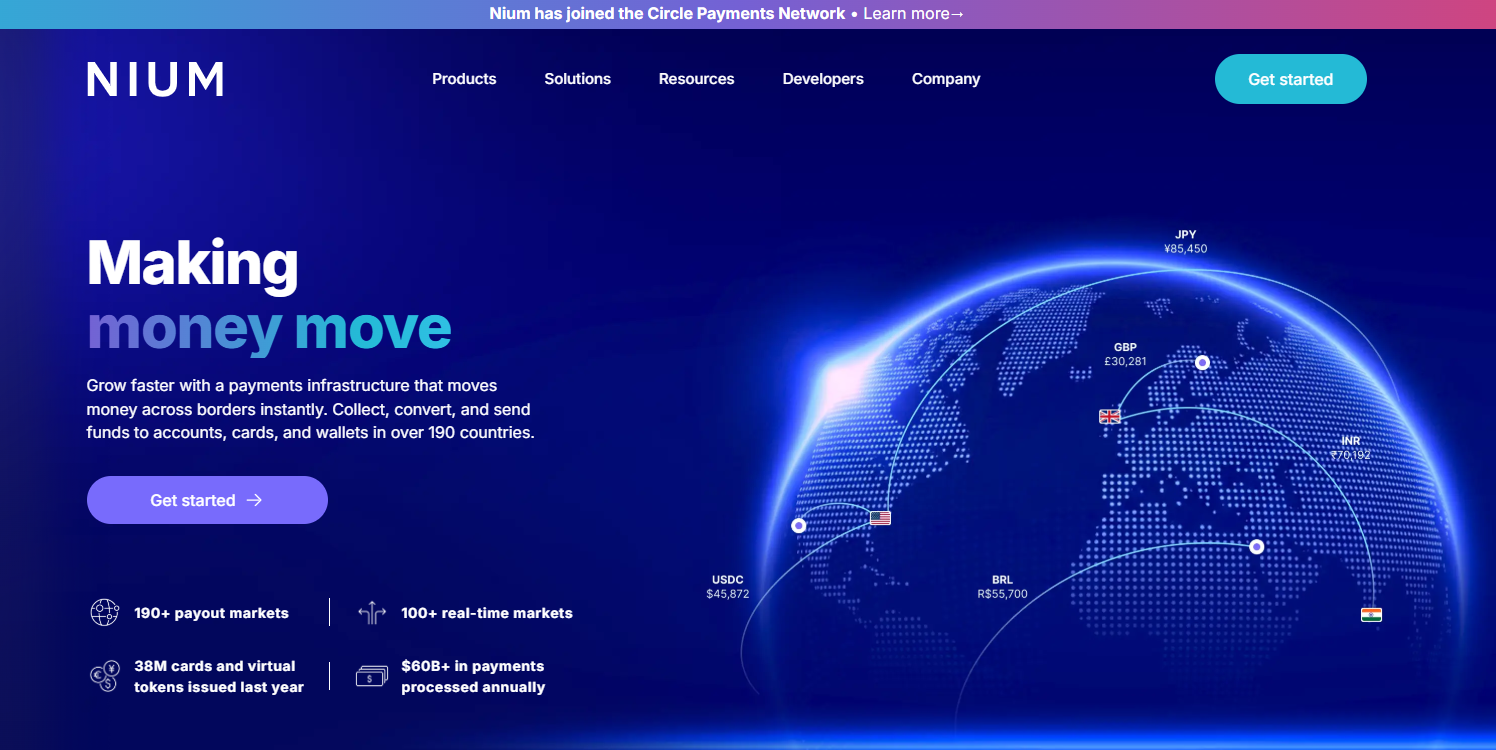
Best for: Banks, payroll platforms and EOR providers exploring institutional payouts and stablecoin settlement through Circle partnership.
Nium pros
Sends funds to bank accounts, wallets and cards from one network
Funding via direct debits across 30+ countries
Circle partnership supports institutional USDC settlement use cases
Strong fit for payroll, EOR, creator payouts and bank partnerships
Nium cons
Real-time reach varies by corridor
Pricing is custom and set through sales
Integration depth may require dedicated engineering
Nium is a strong network for institutional payout use cases. It supports bank, wallet and card destinations, and its direct debit funding footprint can help teams plan recurring payout runs.
The Circle partnership is the most distinctive angle. It gives banks and payroll providers a clearer path to test stablecoin payments while still using last-mile payout rails.
Nium uses custom pricing through its sales team. Scope your payout flows, funding routes and target corridors first so pricing reflects the exact network footprint you need.

Best for: Platforms with diverse recipient preferences that need bank transfers, cards, wallets and cash payouts across 100+ countries.
Rapyd pros
Rapyd Disburse supports payouts to over 100 countries and more than 65 currencies
Method breadth across wallets, cards, bank transfers and cash
Instant card payouts through Visa Direct and Mastercard Send
Unified wallet and mass payout tooling with solid developer docs
Rapyd cons
Country and currency coverage varies by corridor
Rapyd is useful when recipients prefer methods other than bank transfers. Its mix of wallets, cards, bank transfers and cash gives platforms more flexibility in card-heavy or cash-heavy markets.
The strongest fit is a platform with diverse recipient preferences, but each corridor still needs validation.
Rapyd pricing is mostly quote-based. The exchange rate is shown before sending, but you should test target corridors in the sandbox before committing.
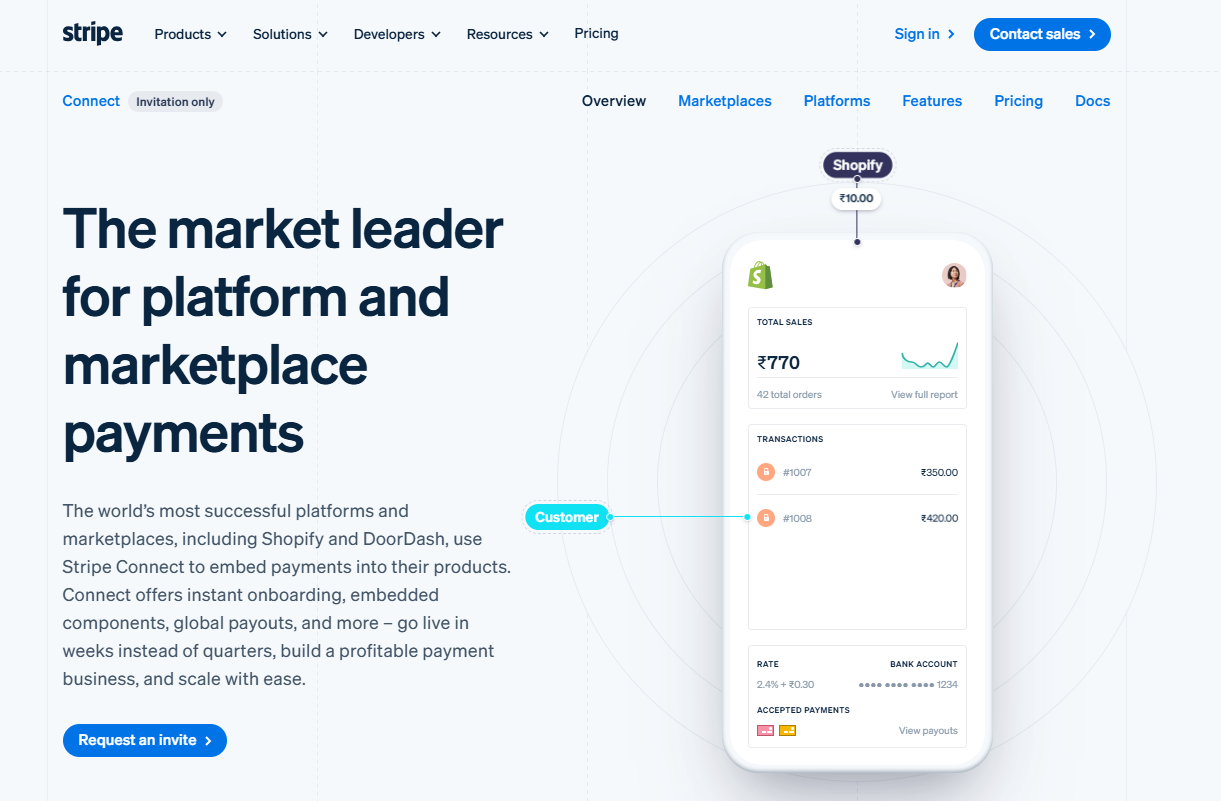
Best for: Platforms already using Stripe for pay-ins that want to add global payouts without a second vendor relationship.
Stripe Connect pros
Stripe Global Payouts can send funds to third parties in local currency
Instant Payouts to debit cards in supported regions
Platform-native revenue tools and embedded components
Mature, well-maintained documentation
Stripe Connect cons
Coverage and eligibility depend on country
Stripe Connect is the natural add-on for platforms that already use Stripe for pay-ins. Global Payouts and Instant Payouts can extend that integration without adding a second vendor for many supported markets.
The tradeoff is eligibility. Stripe is excellent where it fits, but you need to confirm country support, recipient requirements and payout method availability before treating it as a global payout layer.
Stripe lists Instant Payouts at 1.5% of payout volume with a $0.50 minimum, though fees may differ for Connect users. Check the Connect terms for your account before building.
Best for: Marketplaces and platforms needing managed payee onboarding and batch payment workflows for large payout runs.
Payoneer pros
Mass Payout API covering payee registration, account approval and transfers
Batch payments to recipient bank accounts with up to 1,000 payments per file
Mature marketplace tooling for platforms and marketplaces
Flexible file or API workflows for large payout runs
Payoneer cons
Some flows require recipients to register or be linked
Payoneer is a familiar marketplace payouts option with managed onboarding. Its Mass Payout API is useful when you need payee registration and approval inside the payout process. Marketplaces often pair payout tooling with broader operational software like lead generation platforms for growth teams, so the payout provider should sit cleanly alongside the rest of the stack.
The batch model is the main operational benefit. Teams can run large payout files without building a fully custom workflow on day one.
Payoneer fees are disclosed in-account and vary by method and corridor. Review the rates for your main markets before deciding between CSV files and API automation.
Best for: SMBs and startups that need simple, predictable multi-currency batch payouts without heavy implementation work.
Wise Business pros
Batch payments allow up to 1,000 transfers in multiple currencies with one payment
Batch transfers run at the same price and speed as individual transfers
Open API for integrating the Business account into batch payouts
Multi-currency account with clear documentation and predictable per-transfer pricing
Wise Business cons
Batch payments are unavailable for Brazilian businesses
Wise Business is a strong fit for SMBs and startups that need simple global disbursements. Batch payments keep multi-currency payout runs easy to manage without a heavy implementation.
The API gives teams a path to automate later. It is not the deepest enterprise payout network, but it is clear, usable and predictable for smaller teams.
Wise uses per-transfer pricing and offers a fee calculator during scoping. Estimate your corridors first, then decide whether manual batch uploads or API automation make more sense.
Airwallex is the strongest overall pick for platforms that want an operating account, FX and payouts in one vendor relationship. Its public pricing page also makes it easier for finance teams to forecast before engineering starts.
If the problem is fragmentation across payment methods and corridors, Thunes is my top pick for one-integration network reach. It is best suited to PSPs, banks, gig platforms, payroll providers and EOR teams that want to add payout destinations without managing many bilateral bank relationships.
Nium is the runner-up for institutional teams exploring stablecoin settlement, while Rapyd is useful when cards, wallets and cash matter most. Stripe Connect fits existing Stripe platforms, Payoneer fits managed marketplace payouts and Wise Business fits SMB batch needs.
Before choosing, map your priority corridors, recipient preferences and funding routes. Then test the shortlist against that footprint before committing engineering time.
A payout method is how funds reach a recipient, such as a bank transfer, card, mobile wallet, cash pickup or stablecoin wallet. A corridor is the sending and receiving country pair.
Funding routes vary by provider, including local rails, multi-currency balances and direct debits. Your choice affects working capital and operational planning.
Batch limits differ by platform. Payoneer and Wise Business both support files of up to 1,000 transfers in certain workflows, but restrictions can apply.
Instant Payouts usually carry a premium over standard transfers. Compare the added fee with recipient expectations and payout volume before making it the default.
Favor platforms that publish FX markups and transfer fees. For quote-based providers, ask for corridor-level pricing so you can compare like for like.
A note for finance leads reading this alongside a 2026 AP review: the domestic side of the payment stack often needs the same scrutiny as the cross-border side. Once a global payout vendor is chosen, the invoices, approvals, and vendor records still have to move through an AP workflow, and that is usually where the manual work piles up.
 AI tools to find & convert leads.
  Send emails at scale